Skip to content

The last 100 years Red Run Drain

The Red Run hasn’t been a “natural waterway” in over 100 years.
It is definitely part of the Clinton River flow into Lake St. Clair.

Oakland County cities (aka the 12 Towns) have relied on the
storm water drainage of the Red Run for over a century.

All the rain falling from the sky has to go somewhere.
Cities and constant flooding don’t mix well, so the problem
was pushed westward – into Warren – at a lower elevation.

As the climate changes and the cities continue to cover ever piece
of grass with blacktop, concrete, and buildings with roofs, the
storm water just overwhelms the capacity of the drain system.

~~~~~~~~~ click to enlarge ~~~~~~~

Red Run The last 100 years

Red Run The last 100 years

Red Run Corners Map

Red Run Corners Map

Good luck ever actual seeing maps of what exists underground
http://www.dwsd.org/downloads_n/about_dwsd/masterplan_wastewater/volume1/Description_of_Sewer_Service_Districts.pdf

Maps of the districts are found in two reports,
the Segmented Facilities Plan-Book VII (1978) and
the Overview Plan of Wastewater Collection and Treatment
for the Detroit Metro System (1975) (37, 38).
Additional information exists from
Volume 1 Technical Report, Initial Improvements Projects,
Draft NPDES Settlement Permit,
Southeastern Oakland County Sewage Disposal System for George W. Kuhn,
and Retention Treatment Facility Improvements – Oakland County,
Michigan Basis of Design Report (April 2001).

Illegal oil dumping Red Run Drain

A news story released today from WXYZ and Cheryl Chodan
has firefighters putting oil soaking booms into the Red Run
to soak up what appears to be several gallons of motor oil.
http://www.accidentin.com/article_read.php?idLink=72007693&table=ai_news

People need to realize the drain is a Storm Water Drain
and not a sewage drain. Anything dumped into the Red Run
will find its way into the Clinton River and eventually
Lake St. Clair near Harley Ensign Marina and Metro Beach.

Warren has 2 separated systems underground :
- A storm water drain system for rain water
- A sewer drain system for toilet water

The toilet water goes to Warren’s treatment plant,
while the rain water from parking lots and roads does not.
No chemicals should be poured down a street drain grate.

Horizontal piping

Horizontal Piping

GIS Mapping Red Run

GIS Mapping Red Run

Red Run Drain from long ago

Way back in the archives, a story about the Red Run :
http://archive.lib.msu.edu/tic/golfd/article/1979sep14.pdf

For Reference
http://redrundrain.files.wordpress.com/2011/10/overview-map-red-run-kuhn-retention-facility1.jpg

http://redrundrain.files.wordpress.com/2011/07/imgp0051.jpg

~~~~~~ CLICK to enlarge ~~~~~~~~

Old Time Red Run #1

Old Time Red Run #1

Old Time Red Run #2

Old Time Red Run #2

Bidding results Interceptor project

The Oakland Macomb Interceptor Drain Drainage District (OMID)
completed the bidding process for Segment 3 Repair, Contract No. 4.

There is a $ 22.4 MILLION DOLLAR discrepancy
between the high bid and the low bid on this project.

Why ?

If the project section is only worth $ 40 million how can someone
be off by 50% of the value of the project, unless they
simply don’t want it to begin with, or feel a bit greedy ?

Jay Dee Contractors from Livonia,MI was the low bidder:

Jay Dee Contractors—————$ 46.4 million
Michels Tunneling——————-$ 55.9 million
S. J. Louis Construction———–$ 60.8 million
Ric-Man Construction————–$ 64.2 million
SECAC Tunnel———————-$ 65.6 million
Kenny Construction—————-$ 67.2 million
Walsh Construction—————-$ 68.8 million

Wasted Taxpayer Money

After using heavy construction equipment like excavators, bulldozers,
dump trucks, etc. to reshape the banks of the Red Run Drain;
it is all crumbling into the waters of the Clinton River.
The project has failed to stabilize the banks of the Red Run Drain.

Recently April rainstorms washed away the soil, leaving unstable banks,
and an unusable access road between Dequindre and Ryan Road in Warren.
All that dirt and silt end up in the Clinton River which clogs the
gills of trout recently stocked by the DNR as they swim to Lake St. Clair.

When the Red Run fills with massive volumes of water, it begins to back up
the stormdrains of Warren neighborhoods, leading to basement flooding.
When the power goes out, no electricity exists to use sump pumps,
and the residents must buy or rent gas powered generators.
DTE and the Red Run Inter-County Drain Board need to clear trees along
Warren residents fences to keep the power on during thunderstorms.

~~~~~~ CLICK on pictures for complete large full resolution views ~~~~~

red-run-drain-1-april-22-2013

red-run-drain-1-april-22-2013


red-run-drain-2-april-22-2013

red-run-drain-2-april-22-2013


red-run-drain-3-april-22-2013

red-run-drain-3-april-22-2013


red-run-drain-4-april-22-2013

red-run-drain-4-april-22-2013


red-run-drain-5-april-22-2013

red-run-drain-5-april-22-2013


red-run-drain-6-april-22-2013

red-run-drain-6-april-22-2013


red-run-drain-7-april-22-2013

red-run-drain-7-april-22-2013


red-run-drain-8-april-22-2013

red-run-drain-8-april-22-2013


red-run-drain-9-april-22-2013

red-run-drain-9-april-22-2013


red-run-drain-10-april-22-2013

red-run-drain-10-april-22-2013


red-run-drain-11-april-22-2013

red-run-drain-11-april-22-2013


red-run-drain-12-april-22-2013

red-run-drain-12-april-22-2013


red-run-drain-13-april-22-2013

red-run-drain-13-april-22-2013


red-run-drain-14-april-22-2013

red-run-drain-14-april-22-2013


red-run-drain-15-april-22-2013

red-run-drain-15-april-22-2013


red-run-drain-16-april-22-2013

red-run-drain-16-april-22-2013


red-run-drain-17-april-22-2013

red-run-drain-17-april-22-2013

More flooding mid April 2013

FLOOD WARNING
NATIONAL WEATHER SERVICE DETROIT/PONTIAC MI
1033 PM EDT THU APR 18 2013

THE NATIONAL WEATHER SERVICE IN DETROIT/PONTIAC HAS ISSUED
A FLOOD WARNING FOR THE FOLLOWING IN SOUTHEAST MICHIGAN

CLINTON RIVER

HEAVY RAINFALL WEDNESDAY NIGHT AND THURSDAY WILL CAUSE
SIGNIFICANT RISES IN THE RIVERS DUE TO RAPID RUN OFF
OVER GROUND THAT IS ALREADY SATURATED.
ADDITIONAL RAINFALL THROUGH MID FRIDAY MORNING WILL ADD TO
THE RIVER RISE. LEADING TO LEVELS EXCEEDING FLOOD STAGE.

THE NATIONAL WEATHER SERVICE DETROIT/PONTIAC HAS ISSUED A

* FLOOD WARNING FOR THE CLINTON RIVER IN
STERLING HEIGHTS AND CLINTON TOWNSHIP
FROM NOW UNTIL FURTHER NOTICE.
* AT 8 PM THURSDAY THE STAGE IS 13.3 FEET AND RISING.
* FLOOD STAGE IS 16.0 FEET.
* MODERATE FLOODING IS FORECAST.
* FORECAST IS TO RISE ABOVE FLOOD STAGE BY EARLY FRIDAY…
AND CREST AROUND 17.6 FEET FRIDAY EARLY AFTERNOON.

http://water.weather.gov/ahps2/hydrograph.php?wfo=dtx&gage=fsrm4

Flood Level April 18 2013

Flood Level April 18 2013

GIS Drain Mapping Macomb County 2013

Macomb County continues its initiative to use
geographic information system (GIS) for mapping
all the drains in the county

Some 400 miles of underground drains will be mapped via GIS

The concept of managing info geographically goes way beyond a
paper map of yesteryear – all you can do with a paper map
is stick an arrow on it with a note, creating a mess of notes.
A virtual geographic map has 100′s of layers of info for 1 specific dot.
Some call GIS the act of “unlocking data trapped in paper”.

Macomb County GIS Drain Mapping

Macomb County GIS Drain Mapping

2013 Interceptor Drain Meeting Schedule

For residents interested in hearing about latest developments
concerning the Oakland Macomb Interceptor Project in 2013
the meeting schedule is shown below

~~~~~~click to enlarge ~~~~~~~~~

2013 Interceptor Drain Meeting Schedule

2013 Interceptor Drain Meeting Schedule


~~~~~~click to enlarge ~~~~~~~~~
Macomb Oakland Sewage Interceptor

Macomb Oakland Sewage Interceptor


~~~~~~click to enlarge ~~~~~~~~~
Interceptors Oakland Macomb Michigan

Interceptors Oakland Macomb Michigan


~~~~~~click to enlarge ~~~~~~~~~
Interceptor projects Overall View

Interceptor projects Overall View


~~~~~~click to enlarge ~~~~~~~~~
SouthEast Michigan Sewage Districts

SouthEast Michigan Sewage Districts

Dredging on Red Run ?

People I’ve spoken to in 2013 claim no dredging of the Red Run
is planned at this time and all will be quiet in Warren.

There was $3.825 million in federal stimulus money
earmarked for the Red Run Inter-County Drain.

The Oakland County Red Run Drainage District and the
George W. Kuhn Advisory Committee control the Red Run Drain.

The stimulus funding was part of (ARRA)
American Recovery and Reinvestment Act
for the Oakland County 219 program via the
efforts of Congressman Levin.

I’m guessing the 219 Program refers to
Section 219 Environmental Infrastructure
Section 219 of the Water Resources Development Act of 1992

The Red Run flows underground in Oakland County,
only seeing sunshine after it crosses Dequindre Road,
flowing into the City of Warren in Macomb County,
and eventually dumping into the Clinton River.

~~~~~ click on pages to enlarge them ~~~~~~~~~~

Erosion A

Erosion A


Erosion B

Erosion B


Erosion C

Erosion C


Erosion D

Erosion D


Erosion E

Erosion E


Erosion F

Erosion F

Stormwater Southeast Michigan

Noticed a lot of searches for “”storm drains“” the past few days.
They exist everywhere around us via ditches on the sides of roads,
metal grates on the subdivision streets, municipal streets, highways, etc.
A storm drain deals with rain water – a sewer drain deals with toilet water.

The City of Warren,Michigan has confused the public by using the term
—– Municipal Separate Storm Sewer Systems —–
It really should differentiate the 2 unique and individual systems.
a.) Storm Water Drains
b.) Sewage Water Drains

Educate your kids and yourself:
- no one is sweeping sewage off the streets into sewer grates
It’s called a Storm Drain , for rain falling from the sky !

Got Questions – Call the Warren DEQ Office

DEQ Remediation and Redevelopment Division,
27700 Donald Court, Warren, MI 48092-2793
It is right off of Tank Road aka Martin Road ,
north of 11 Mile & VanDyke, in Warren,MI

~~~~~~click to enlarge the picture ~~~~~~~~

Southeast Michigan Stormwater

Southeast Michigan Stormwater

James Van Havermaat, P.E.
City Engineer
Engineering Division
One City Square, Suite 300
Warren, Michigan 48093-2390
Phone: (586) 759-9300

If you see illegal dumping into a street storm drain, a ditch or a creek
Call Public Works Commissioner Anothony V. Marrocco’s HOTLINE
at 1-877-679-4337 and report the activity.

Warren has a Public Education Program (PEP)
– Education and Outreach on Storm Water Impacts

The PEP shall promote, publicize, and facilitate watershed
education for the purpose of encouraging the public to
reduce or prevent the discharge of pollutants in storm water
to the maximum extent practicable.
Since combining or coordinating existing PEPs for public stewardship
of water resources is encouraged by the Department,
the City of Warren has contracted with the Clinton River Watershed
Council to provide public education services.

In addition, the City recognizes and utilizes the educational
resources offered by the Department of Natural Resources and
Environment, the Southeast Michigan Council of Governments,
the Macomb County Public Works Office, the Macomb County Health
Department, and the Michigan State University Extension.

These are the storm water drains in the local area of Warren :

Traditional Flat Paper Map

Traditional Flat Paper Map

Red Run Drain Map Clinton River

Red Run Drain Map Clinton River

Multiple Drains Warren Michigan

Multiple Drains Warren Michigan

NAME OF COUNTY DRAIN

Baseline —–Warren,Michigan
Bear Creek —–Warren,Michigan
Bear Creek Enclosure —–Warren,Michigan
Bear Creek Twelve Mile Enclosure —–Warren,Michigan
Bear Creek Warren Branches —–Warren,Michigan
Bear Creek Warren Branches #2 —–Warren,Michigan
Beaver Creek Drain & Branches (Inter County) —–Warren,Michigan
Bolam —–Warren,Michigan
Brieholz —–Warren,Michigan
Brinker —–Warren,Michigan
Brinkman —–Warren,Michigan
Buckland —–Warren,Michigan
Burg —–Warren,Michigan
Burnett —–Warren,Michigan
Cadillac Ave E. —–Warren,Michigan
Cadillac Ave W. —–Warren,Michigan
Caplean —–Warren,Michigan
Center Line Relief —–Warren,Michigan
Center Line Relief & Branches —–Warren,Michigan
Center Line Tile —–Warren,Michigan
Chambers Ave Lat. —–Warren,Michigan
Chartier —–Warren,Michigan
Clinton River —–Warren,Michigan
Clinton River Basin —–Warren,Michigan
Clinton River Spillway —–Warren,Michigan
Conner Creek —–Warren,Michigan
Continental Avenue E Lateral —–Warren,Michigan
Continental Avenue W Lateral —–Warren,Michigan
Coolidge Ave. Lat. —–Warren,Michigan
Cramer —–Warren,Michigan
Cramer Relief & Brs. —–Warren,Michigan
Deierline —–Warren,Michigan
Denewith —–Warren,Michigan
Doage Ave E. Lat. —–Warren,Michigan
East Branch —–Warren,Michigan
Edman —–Warren,Michigan
Edman Enclosure —–Warren,Michigan
Eight Mile Van Dyke —–Warren,Michigan
Elwart —–Warren,Michigan
Englebert —–Warren,Michigan
Engleman —–Warren,Michigan
Essex Ave —–Warren,Michigan
Fink —–Warren,Michigan
Flora Avenue W Lateral —–Warren,Michigan
Fogg —–Warren,Michigan
Fogg Enclosure —–Warren,Michigan
Fora Ave E. —–Warren,Michigan
Foster —–Warren,Michigan
Grand Trunk —–Warren,Michigan
Grobbel —–Warren,Michigan
Grobbel Relief & Branches —–Warren,Michigan
Grobbel Relief & Branches No 2 —–Warren,Michigan
Groesbeck —–Warren,Michigan
Harrington Extension East —–Warren,Michigan
Harrington Extension West —–Warren,Michigan
Hartlein Relief —–Warren,Michigan
Hartman —–Warren,Michigan
Hartsig —–Warren,Michigan
Hartsig Relief & Branches —–Warren,Michigan
Helen Ave. —–Warren,Michigan
Henry Ave W. —–Warren,Michigan
Hessell —–Warren,Michigan
Hudson Ave. E. —–Warren,Michigan
Hupp Ave. W. —–Warren,Michigan
Irving Road —–Warren,Michigan
Jenerous Ave —–Warren,Michigan
Jewett Ave. —–Warren,Michigan
Kuss —–Warren,Michigan
Kutchey Inter County Drain —–Warren,Michigan
Kutchey Thomas Relief —–Warren,Michigan
Kutchey Warren Branches —–Warren,Michigan
Leland —–Warren,Michigan
Lorna —–Warren,Michigan
Lorraine Storm —–Warren,Michigan
Lorraine Storm #1 —–Warren,Michigan
Lorraine Storm #2 —–Warren,Michigan
Maes —–Warren,Michigan
Marion Ave —–Warren,Michigan
Masch —–Warren,Michigan
Maulberg —–Warren,Michigan
Maxwell —–Warren,Michigan
McCoy —–Warren,Michigan
McCoy Relief —–Warren,Michigan
McCoy Relief Warren Branches —–Warren,Michigan
Meckler Relief & Branches —–Warren,Michigan
McCoy Relief Warren Branches —–Warren,Michigan
Meckler Tiling —–Warren,Michigan
MecklerMierow —–Warren,Michigan
Mierow —–Warren,Michigan
Miller —–Warren,Michigan
Mound Park —–Warren,Michigan
Murthum Relief —–Warren,Michigan
Nagle Arm —–Warren,Michigan
Nine Mile Halfway —–Warren,Michigan
North Lorraine Arm —–Warren,Michigan
North VanDyke Arm —–Warren,Michigan
Northampton Pump Station —–Warren,Michigan
O’ Meara —–Warren,Michigan
Oehmke —–Warren,Michigan
Otto —–Warren,Michigan
Paige Ave E. —–Warren,Michigan
Paige Ave W. —–Warren,Michigan
Rausch —–Warren,Michigan
Red Run —–Warren,Michigan
Red Run Warren Branches —–Warren,Michigan
Red Run Warren Branches #2 —–Warren,Michigan
Red Run Warren Outlet —–Warren,Michigan
Renge —–Warren,Michigan
Republic Avenue East Lateral —–Warren,Michigan
Rinke —–Warren,Michigan
Rinke Englebert —–Warren,Michigan
Ruhl —–Warren,Michigan
Rumpa —–Warren,Michigan
Rumpa Enclosure —–Warren,Michigan
Rumpakuss —–Warren,Michigan
Ryan —–Warren,Michigan
Schattler —–Warren,Michigan
Schoenherr Flanders —–Warren,Michigan
Schoenherr Fourteen Mile —–Warren,Michigan
Schoenherr Relief & Branches —–Warren,Michigan
Schoenherr Relief & Branches #1 —–Warren,Michigan
Schroeder —–Warren,Michigan
SchroederOtto —–Warren,Michigan
SchroederSzaboOtto —–Warren,Michigan
Sharkey —–Warren,Michigan
Sharkey Relief —–Warren,Michigan
Sharkey Relief/Ryan —–Warren,Michigan
Sharkey Warren Branches —–Warren,Michigan
Sherwood —–Warren,Michigan
Smith —–Warren,Michigan
Smith Rivard Branches —–Warren,Michigan
South Van Dyke Arm —–Warren,Michigan
Spence —–Warren,Michigan
Spieler Ave E. —–Warren,Michigan
Spiller —–Warren,Michigan
Sprenger —–Warren,Michigan
St Clements —–Warren,Michigan
Standard Ave. E. Lateral —–Warren,Michigan
Standard Ave. W. Lateral —–Warren,Michigan
State Park E. Lateral —–Warren,Michigan
Stebbins & Base Line —–Warren,Michigan
Stevens Baseline —–Warren,Michigan
Streifkirk Tile —–Warren,Michigan
Studebaker —–Warren,Michigan
Superior Ave. —–Warren,Michigan
Szabo —–Warren,Michigan
Ten Mile East Lateral —–Warren,Michigan
Timken Avenue East Lateral —–Warren,Michigan
Toll —–Warren,Michigan
Walker Relief —–Warren,Michigan
Warren Catch Basin Repair —–Warren,Michigan
Warren Catch Basin Repair #2 —–Warren,Michigan
Warren Catch Basin Repair #3 —–Warren,Michigan
Warren Catch Basin Repair #4 —–Warren,Michigan
Warren Catch Basin Repair #5 —–Warren,Michigan
Warren Catch Basin Repair #6 —–Warren,Michigan
Warren Catch Basin Repair #7 —–Warren,Michigan
Warren Catch Basin Repair #8 —–Warren,Michigan
Warren Sanitary —–Warren,Michigan
Weigand —–Warren,Michigan
Wiegand Park Lateral —–Warren,Michigan
West Branch —–Warren,Michigan
Westphal —–Warren,Michigan
Wiegand —–Warren,Michigan
Williams —–Warren,Michigan
Wood Avenue & Branch —–Warren,Michigan

Flooding predicted by NOAA

Weather alerts went out at 11:30 pm on Wednesday April 10, 2013
specifically for the Clinton River from Pontiac and Sterling Heights

Inevitably that means LOTS of water will be dumped into the Red Run
coming from the rainstorms in Oakland County
Watch for overflows marked : SOCSDS (George W. Kuhn) Retention Basin

If you wonder if a release occurred you can check Facebook
https://www.facebook.com/pages/Macomb-County-Health-Department-Sewer-Overflow-Notifications/121109304596880

The intensity and duration of the rainfall is what may trigger
a discharge to occur into the Red Run, not necessarily
just an “X” amount of precipitation.

You can also check Michigan DEQ Discharges
http://www.deq.state.mi.us/csosso/events_by_entity.asp?lstEntity=108&cmdSubmit=Submit

~~~~click to enlarge picture ~~~~~~
-
http://water.weather.gov/ahps2/hydrograph.php?wfo=dtx&gage=fsrm4
-

Flood prediction Red Run

Flood prediction Red Run

FLOOD WARNING
NATIONAL WEATHER SERVICE DETROIT/PONTIAC MI
1055 PM EDT WED APR 10 2013

THE NATIONAL WEATHER SERVICE IN DETROIT/PONTIAC HAS ISSUED A
FLOOD WARNING FOR THE FOLLOWING IN SOUTHEAST MICHIGAN…

…..CLINTON RIVER…

RAINFALL OVER THE LAST TWO DAYS AND FORECAST RAINFALL
AMOUNTS OF AN ADDITIONAL ONE TO POSSIBLY TWO INCHES
HAS BEEN LEADING TO SIGNIFICANT RISES ON AREA RIVERS.

THE NATIONAL WEATHER SERVICE DETROIT/PONTIAC
HAS ISSUED A :

* FLOOD WARNING FOR THE NORTH BRANCH CLINTON NEAR MT CLEMENS..
* FROM NOW UNTIL FURTHER NOTICE.
* AT 10 PM WEDNESDAY THE STAGE IS 7.0 FEET AND RISING.
* FLOOD STAGE IS 15.0 FEET.
* MINOR FLOODING IS FORECAST.
* FORECAST IS TO RISE ABOVE FLOOD STAGE BY FRIDAY EARLY AFTERNOON
AND CREST AROUND 15.9 FEET EARLY SATURDAY .
* FLOOD HISTORY…THIS CREST COMPARES TO A PREVIOUS CREST
OF 15.1 FEET ON DEC 1 2011.
~~~~~~~~~~~~~~~~~~~~~~~~~~~~~~~~~~~~~~~~~~~~~~~~~~~~~~~~~~~~~~~~~~~
FLOOD WARNING
NATIONAL WEATHER SERVICE DETROIT/PONTIAC MI
1055 PM EDT WED APR 10 2013

THE NATIONAL WEATHER SERVICE IN DETROIT/PONTIAC HAS ISSUED
A FLOOD WARNING FOR THE FOLLOWING IN SOUTHEAST MICHIGAN…

…CLINTON RIVER…

THE NATIONAL WEATHER SERVICE DETROIT/PONTIAC HAS ISSUED A

* FLOOD WARNING FOR THE CLINTON RIVER IN STERLING HEIGHTS
AND CLINTON TOWNSHIP FROM NOW UNTIL FURTHER NOTICE.
* AT 7 PM WEDNESDAY THE STAGE IS 11.8 FEET AND RISING.
* FLOOD STAGE IS 16.0 FEET.
* MINOR FLOODING IS FORECAST.
* FORECAST IS TO RISE ABOVE FLOOD STAGE BY THURSDAY EVENING
AND CREST AROUND 16.1 FEET THURSDAY NIGHT.

Precipitation
http://www.srh.noaa.gov/ridge2/RFC_Precip/?site=dtx&lat=43.5&lon=-83.5&zoom=3

Precipitation April 10 2013

Precipitation April 10 2013

Update from the FreePress newspaper – 7:35 AM, April 11, 2013
http://www.freep.com/article/20130411/NEWS05/130411009/Rain-continues-through-Friday-flood-warnings-in-Macomb-and-Wayne-counties

Electrical Lines and Trees

Some residents of Warren have backyards adjacent to the Red Run Drain.
DTE years ago, ran the electrical lines along the fence line with telephone poles
in the corners of many peoples back yards on residential property.

The catch : Trees on the “other side” of the fences
i.e. the Red Run Drain property often break, crack, fall
on the power lines creating frequent power outages for residents.

DTE has a strict – 10 Foot Rule – for trimming near primary lines.
They will go in the backyard of a paying customer and trim the branch
or tree that is causing an issue at that particular moment.
Warren is on schedule for a “trimming” in 2014 along the Red Run Drain.

Often trees – farther than 10 feet away from the power line – fall.
DTE has never cleared a path along the power lines as part of
a preventative measures program and has no plans to do so.
They prefer to go, yard to yard to yard, of individual property owners,
instead of cutting trees on county owned land along the Red Run Drain.

An example:
Maybe they should actually clear the fence lines and power lines.
The land where the trees actually exist, belongs to the county.

Power Line Clearing

Power Line Clearing

If you have questions about the line clearance work in your neighborhood,
please call DTE Customer Service Line at 800.477.4747

Red Run Corners

Red Run Corners dates back to mid 1800′s
associated with the Cady Post Office
and GTRW railroad Utica Plank station.

The river was originally named via
Nottawaseppi by
Huron Band of the Potawatomi http://www.nhbpi.com/

~~~~~~~click with mouse to enlarge pictures~~~~~~~

Red Run Corner Cady Corner

Red Run Corner Cady Corner


Red Run Corners Map

Red Run Corners Map


Red Run Corners Cady Post Office

Red Run Corners Cady Post Office


Red Run Corners Village

Red Run Corners Village


Cady Post Office Red Run Corners

Cady Post Office Red Run Corners

Title: Combination atlas map of Macomb County, Michigan
Author: Stewart, D. J.
Publication Info: Philadelphia : D. J. Stewart, 1875.

Title: Atlas of the state of Michigan : including statistics and descriptions
of its topography, hydrography, climate, natural and civil history,
railways, educational institutions, material resources, etc. /
by Alexander Winchell … [et al.] ; drawn, compiled, and edited by H. F. Walling.
Author: Walling, Henry Francis, 1825-1888.

MDEQ & EPA protect ?

When contaminated groundwater leeches into underground aquifers,
consent agreements take place regarding the clean-up.
The consent judgments, on occasion, get amended a few times,
and sometimes the court issues other additional cleanup-related orders.

These agreements often take place in courts
- with little or no opportunity for public input.

MDEQ has to accept “”remediation plans”"  that comply with state law.

The Natural Resources & Environmental Protection Act (NREPA) of Michigan
has a little paragraph (Part 201, Section 2a) that basically claims
— MDEQ is required to approve changes to legal agreements —

Sometimes a proposal lacks adequate monitoring planning
and/or contingency planning to deal with the spreading contamination
and there could be uncertainty about migration pathways.

Sound familiar – it should – The G & H Landfill on the Clinton River

Reading between the lines, When cleanup efforts get too expensive
the rules get changed by court order to help industry survive.

It all gets real interesting when “standards” get changed.
Michigan recently modified the Dioxane Standard.
The U.S. Environmental Protection Agency (EPA) changed
Michigans current standard for Dioxane in Drinking Water.
- New standard is 85 parts per billion (ppb)
of 1,4 dioxane in drinking water
while in the 1980s, the acceptable level in Michigan was just
3 parts per billion (ppb).

Strict cleanup requirements get loosened to “aid” the
financial burden on industry by putting Michigan’s residents
health concerns on the back burner.
Items involving the financial assurance from a company
to carry out “a cleanup to completion” seem to outweigh the
general protection of public health, safety, welfare and the environment.

If a  “prohibition zone” is enacted, that area could have even higher levels of Dioxane.
Levels of 2,799 ppb of 1,4 dioxane exist near Ann Arbor, closing wells.
People in the zone can’t use their wells, are required to hook up to the
city water and sewer system – almost all at their own personal expense.

Still think the government is protecting you and working for your best interest ?

Additional info can be found here:
Ann Arbor area and the Huron River

- http://annarborchronicle.com/2011/04/07/residents-frustrated-by-dioxane-decision/

- http://annarborchronicle.com/wp-content/uploads/2011/04/PallGelmanMarch2011ConsentJudgment.pdf

- http://annarborchronicle.com/wp-content/uploads/2011/04/ExpandedProhibitionZoneMapLarge.jpg

- http://annarborchronicle.com/wp-content/uploads/2011/04/March2011Prohibition-Zone-Map.pdf

Video of the public meetings exists as well
http://www.youtube.com/view_play_list?p=9CAFB19D7AB1C833

DEQ open house in Warren on March 28, 2013

MARCH 28, 2013 = Session I from 9AM-12PM and Session II from 1PM-4PM

SPRING OPEN HOUSE,

MICHIGAN DEPARTMENT OF ENVIRONMENTAL QUALITY,
WATER RESOURCES DIVISION, WATER RESOURCE UNIT,

- DEQ WARREN OFFICE, MICHIGAN. -

DEQ Remediation and Redevelopment Division,
27700 Donald Court, Warren, MI 48092-2793

That area right off of TANK ROAD aka Martin Road  ,

north of 11 Mile & VanDyke, in Warren,MI

Isn’t it nice to know the DEQ has people constantly onsite
-right next to “industry” & “military” -
in Michigan’s 3rd largest city aka Warren,Michigan.
Learning what went into the ground years ago in
Warren plays a big role in what seeps where now in the water table
and underground infrastructure of cracked pipelines.
I doubt residents will ever get exact answers from the
military or industrial base of Warren.

The DEQ Water Resources Division, Water Resource Unit permitting staff
will be available for both sessions for consultation regarding
any inland lake or stream, Great Lake, wetland or floodplain permit.
Michigan DNR Fisheries staff and USACE staff will
also be available for questions.

You are invited to join staff of the Michigan Department of
Environmental Quality (DEQ), Michigan Department of
Natural Resources (DNR), and the U.S. Army Corp of Engineers (USACE)
for informational sessions on the following topics:
- changes proposed to streamline Great Lakes dredging projects,
- proposed changes to DEQ Statewide Minor & General permit categories,
- permit process for each agency.

Any interested citizens are welcome and encouraged to attend.
Questions about this event may be directed to
Andrew Hartz, Water Resources Division at 586-753-3867
or Hartza@michigan.gov

Will the Red Run Drain shoals be dredged in the near future ?
http://redrundrain.wordpress.com/project-for-2-counties/

Kwawme water drain fiasco

All the recent chaos surrounding past water and sewage drain deals
involving Kwawme Kilpatrick cast a bad light on the current
Oakland/Macomb Interceptor work done by those same contractors.

Warren borders Detroit and is hooked into many of DWSD drain systems.

Crain’s Detroit Business
March 17, 2013 8:00 AM
Biz takes the stand:
Key testimony against ex-mayor Kilpatrick

‘FORCED MARRIAGE’
Kathleen McCann

• CEO, United Road Services Inc., Romulus

• Testified Dec. 7 and 10, 2012, regarding count 1, racketeering,
Kwame Kilpatrick and Bobby Ferguson; counts 2 and 3, extortion,
Ferguson; count 11, extortion, Kilpatrick and Ferguson.
Count 11 was dismissed.

Kathleen McCann, a former senior vice president of Soave Enterprises Inc.,
recounted meeting with Bobby Ferguson in early 2002 after CEO
Anthony Soave visited Kwame Kilpatrick and was informed that Soave’s
proposed subcontractor on a sewer lining contract
“was out and Ferguson was in.”

McCann joined Soave Enterprises in 1990, around the time Soave acquired
what is now Inland Waters Pollution Control Inc. and appointed her to
the Inland board. Soave has since sold all but 10 percent in that
company. Kilpatrick administrative aide Derrick Miller later checked up
with McCann on the status of negotiating Ferguson’s share of that
contract during the 2002 Mackinac Policy Conference, a conversation
that she said made her uncomfortable.

“We were essentially in a forced marriage, and we knew that this was a
relationship that we were going to have to endure, and so we did our
very best to ultimately get to these contractual arrangements …
to satisfy the promise we made … to do this work,” she testified.

She testified that Ferguson ultimately negotiated for a 20 percent, or
$10 million, share of contract revenue on the lining contract and for
a share of the profits. He allegedly sought to expand on that same
arrangement when Inland Waters became prime contractor on emergency
repairs to a sinkhole in Sterling Heights.

She also compiled a company “diary” starting around 2003 to document
illegal or questionable requests that Miller, Ferguson and others
made of Soave or Inland.

Why her testimony is important: McCann told jurors that Soave and
Inland Waters received veiled threats and that the “risk of losing
the work kind of was hanging over our heads.”

Since then: McCann left Soave in 2011 and became president of
Romulus-based United Road Services.

THE ‘RIGHT’ CONTRACTOR
Anthony Soave

• President-CEO, Soave Enterprises Inc., Detroit; part owner,
former full owner, Inland Waters Pollution Control Inc.,
Detroit; owner, City Aviation Services Inc.

• Testified Dec. 5-7, 2012, regarding count 1, racketeering,
Kwame Kilpatrick and Bobby Ferguson; counts 2 and 3, extortion,
Kilpatrick; counts 18-30, mail and wire fraud, Kilpatrick.
Counts 27 and 29 were dismissed.

After Kwame Kilpatrick became mayor, Anthony Soave testified,
that a $50 million sewer lining contract his company Inland Waters
Pollution Control had at the close of the Dennis Archer administration
was still languishing on the mayor’s desk. He paid a visit in
April 2002 to ask why.

At that time, Inland had hired a company owned by former
Detroit Water and Sewerage Department Director
Charlie Williams as a subcontractor.

“I just asked (Kilpatrick) what was wrong, and he said I had the
wrong subcontractor. I think I asked him, ‘What’s the right one?’
So he told me, Ferguson was the right one.”

Ferguson then displaced Williams’ company on the contract, but
Soave said he “felt bad” for Williams and paid him $200,000.
Soave is now a 48 percent owner of Williams’ contracting
company, MPS Industrial Services.

He also told jurors he allowed Kilpatrick and his family the use
of private planes through his company City Aviation Services Inc.
for at least 20 round trips, including from the Bahamas to Detroit
and back again during and after the summer 2003 power blackout
in Michigan, and shopping trips to New York.

Between 2004 and 2008, he also donated $175,000 to the nonprofit
Kilpatrick Civic Fund, which other witnesses established the
mayor used for personal and political expenses.

While Soave said he was reluctant to get on bad terms with the
mayor, he was more firm with Ferguson and resisted efforts to
grow Ferguson’s share of the profits or to be paid for
work he didn’t perform.

“(Vice President Kathleen McCann told me that) Bobby said next time
we bid on the next contract, he wants to be our partner, (that)
he wants to bid … (as) either as a partner or 50-50,” he said.
“I told her, ‘You can tell him to go F himself.’
I’d rather not have the work than be partners with him.”

Why his testimony is important: Although McCann handled many of the
particulars of dealing with Ferguson, Soave’s testimony explained
the mayor’s role in the leverage that Ferguson was able to gain.

Since then: Soave sold an 80 percent stake in Inland Waters,
which he acquired around 1990, to Strength Capital in 2005.
He retains a 10 percent share after selling another 10 percent.

SINKHOLE REPAIR PROJECT
Walter Rozycki

• Senior project manager and sales manager,
Inland Waters Pollution Control Inc., Detroit

• Testified Jan. 16, regarding count 1,
racketeering, and count 3, extortion, Bobby Ferguson.

An 11-foot-diameter sewer interceptor — then owned by the
Detroit Water and Sewerage Department near 15 Mile and Hayes
in Sterling Heights — collapsed in August 2004,
causing part of the roadway to sink as well.

Repairs took about a year to complete, and project manager
Walter Rozycki was site representative for Detroit-based
Inland Waters Pollution Control, the general contractor on the project.

Rozycki testified that Bobby Ferguson first reported to the site
on Sept. 14 and a work crew showed up the following day.
Ferguson’s Enterprises Inc., as a subcontractor, handled excavation
work for a bypass to be installed at the sinkhole site, as well as
fueling generators, site restoration and landscaping.

Rozycki reviewed invoices and work records submitted on site but
said a federal agent later showed him other invoices on behalf
of Ferguson’s company billing for work before he was hired at
the project site. In one case, the record appears to be a bill
before the sinkhole had even happened.

Why his testimony is important: Prosecutors alleged Kilpatrick
steered a portion of the sinkhole repair project to Ferguson’s
company and held up approval of a contract amendment for
Inland Waters until it agreed to pay Ferguson at least $350,000
for work his company did not perform.

LAKESHORE LEARNS HOW TO PLAY BALL
Avinash Rachmale

• Chairman, Lakeshore TolTest Corp.
and The Lakeshore Group, Detroit

• Testified Nov. 15-27, 2012, regarding count 1, racketeering,
Bobby Ferguson, Kwame Kilpatrick and Bernard Kilpatrick;
counts 7-9, extortion, Ferguson and Kwame Kilpatrick.
There was no verdict on count 1 for Bernard Kilpatrick,
and no verdict on counts 7 and 8 for Kwame Kilpatrick.

Avinash Rachmale testified that his then-midsize business,
Lakeshore Engineering Services Inc., was in dire straits
after losing two city contracts, until he made Bobby Ferguson
a subcontractor on sewer repairs in 2004 and got the work.

His subsequent move to give in and play ball enriched Ferguson’s
companies more than $1.7 million for work not performed,
prosecutors argued.

Rachmale testified that Lakeshore lost two contracts totaling
$15 million to a competitor in 2003, including one it had
previously won, after Ferguson, as a subcontractor to the
competitor, asked to be dealt in for 25 percent of the work
– and was rebuffed.
At the time, Lakeshore’s entire annual revenue
was only about $15 million.

“It was devastating that both contracts (were) canceled, and I
had stomach aches and I couldn’t come to the office for a while,”
Rachmale said. “I just felt that we worked all along
… writing these humongous proposals, and ultimately
our jobs are canceled.”

Rachmale later agreed to deal Ferguson in for a 36 percent cut of
a contract for inspection and rehabilitation of 10 outfalls
(stormwater discharge points).

Doing so meant having to exclude Hayes Excavating Co., an excavating
subcontractor Lakeshore had used in the previous failed bids.
Rachmale did it, but felt the Ferguson cut was oversized for its
relatively small share of work. Lakeshore landed that contract
in late 2004, and Hayes Excavating went out of business sometime
later, Rachmale testified.

Why his testimony is important: Rachmale’s tale of reversing his
fortunes after paying Bernard Kilpatrick consultant fees and
meeting with Ferguson helped prosecutors establish he was initially
extorted out of the first two contracts. Prosecutors also established
Ferguson got 5 percent of a subsequent asbestos contract for which
he did no work — the basis of a single charge on which Ferguson
was convicted, but jurors could reach no verdict for Kilpatrick.

Since then: Rachmale is now chairman of Lakeshore TolTest Corp.,
formed after Lakeshore merged with Toledo-based TolTest Corp. in 2010.

DLZ: IN AND OUT OF FAVOR
Pratap Rajadhyaksha

• Former COO, DLZ Corp., Columbus, Ohio

• Testified Oct. 24, 2012, regarding count 1, racketeering,
Bobby Ferguson; count 6, bribery, concerning programs that
receive federal funds, Ferguson and Kwame Kilpatrick.
Count 6 was dismissed.

In early 2004, Ohio-based DLZ Corp., through its Detroit-based
DLZ Michigan Inc. subsidiary, was asked to replace a downtown
water main by the Detroit Water and Sewerage Department in
time for Super Bowl XL in 2006.

DLZ, a project manager, had just used Bobby Ferguson’s
Ferguson’s Enterprises Inc. on a pilot program for the city.
But after soliciting competitive bids on the new project,
DLZ selected three other companies.

COO Pratap Rajadhyaksha testified that then-water department
Director Victor Mercado had advised him that Ferguson should
be awarded some of the work, even though Ferguson’s bid
was substantially higher. DLZ complied.

Rajadhyaksha said Ferguson became the most difficult project
contractor to work with, seeking to be paid for several
change orders that Rajadhyaksha thought were unjustified.

Ferguson’s company ultimately received more than $4 million
on the downtown water main project.

In 2006, DLZ was competing on a follow-up contract to service
the city’s east side water mains but, Rajadhyaksha testified,
it lost that job after its certification as a Detroit-based business
was revoked by the Detroit Human Rights Department.

Why his testimony is important: Prosecutors contended DLZ actually had
a more competitive bid on the east side mains project than
Lakeshore Engineering Services, which had teamed with Ferguson.
But Kilpatrick had directed Human Rights to revoke DLZ’s certification.
The government also contends Kilpatrick benefited financially
from his efforts to steer the project toward Ferguson.

Detroit Water Sewage to go regional 2013 ?

Michigan State representative pushing DWSD absorption
American Water Intelligence – Vol 4, Issue 3 (March 2013)

A draft bill would create an inter-city authority to supersede the
Detroit Water & Sewerage Department.

The beleaguered Detroit Water and Sewerage Department (DWSD) is
facing a state bill that could strip the utility of its recently
restored managerial autonomy. If passed, the legislation would
establish a new regional water and sewer authority
that would absorb the DWSD.

Michigan state representative Kurt Heise (R-20th District) introduced a
bill in late January 2013 calling for the creation of a new regional
water authority to oversee the DWSD’s assets.

One representative in each of the 126 municipal governments in the DWSD’s
service area would be appointed to the authority’s board, giving Detroit
the same representation as each of the DWSD’s suburban customers.
The board would also have a 13-member executive committee, of which
Detroit’s representative would be a permanent member.
Detroit would maintain ownership of its water and wastewater treatment
facilities and infrastructure.
The DWSD had no comment on the bill, and a department spokeswoman
told AWI that DWSD’s main concern is its internal reforms.

The DWSD is struggling after years of financial troubles, ethics scandals
and population decline. In addition, the utility is still involved in
a 36-year-old lawsuit with the EPA due to an environmental consent decree.
The DWSD has been under the jurisdiction of a federal judge since 1977,
and a new judge, Sean Cox, was appointed to the case in 2010.
Former Ann Arbor, Mich., public services director Sue McCormick was
appointed DWSD director in January 2012.

In August 2012, the department hired EMA, Inc. to evaluate its operations,
and the firm recommended that DWSD eliminate 81 percent of its workforce.
The contract to hire EMA to help implement the cuts was rejected by the
Detroit City Council, which must approve contracts over $2 million.

The DWSD could side-step the city council by bidding out all its proposed
work in $2-million-sized pieces, but such an approach would mean writing
and approving dozens of contracts. Heise, who was director of the
environment department of Wayne County, Mich., from 2002 to 2009 and
oversaw one of the DWSD’s wastewater treatment plants, said his bill is
meant to end the political impasse by forcing action or replacing
the current arrangement outright.

“It is a firewall against the current state of affairs.
If Judge Cox cannot or will not make this happen,
then my bill is ready to go,” Heise told AWI.
“I also believe that, in the long run,
it is the best option for the region.”

Heise introduced a similar bill in 2011 that died in committee,
but he said times have changed. Democrats from Detroit are
open to the bill as a way to protect the DWSD, he added.

“They’re trying to protect DWSD. They’re trying to negotiate a better
deal for DWSD so that it does not become a pawn – a bargaining chip –
in the financial bankruptcy and financial reorganization
of the City of Detroit.”

Failure on Red Run stormdrain

Even after spending huge sums of tax money, the banks of the
Red Run stormdrain are now failing, literally collapsing into
this tributary of the Clinton River in Warren, Michigan.

See all the pics taken March 14, 2013 in this album

https://plus.google.com/108590711667865641354/posts/AdBjvbKEQ8N
or
https://picasaweb.google.com/108590711667865641354/RedRunBankFailureForSpring2013

~~~ click on pictures to see full size ~~~
Red Run 102 March 14, 2013

Red Run 107 March 14, 2013

Red Run 118 March 14, 2013

Red Run 122 March 14, 2013

2013 Precipitation forecast ?

Weather forecasters generally agree 2012 was very, very dry in Michigan.
Some would say drought like conditions existed most of the year.

2011 was a wake-up call to many involved with stormwater in Michigan

According to NOAA, the annual precipitation total for all of Michigan
in 2011 was 36.45 inches. The 2011 year had some very large rainstorms.

Overall SSO Events SE Michigan

Overall SSO Events SE Michigan

SSO’s are releases of raw sewage from
separate sanitary sewer collection systems, which are
designed to carry sanitary sewage – but not storm water.

SSO’s are illegal – and usually constitute a serious environmental and
public health threat. Sewage discharges into basements may also occur,
but these events are not required to be reported to the DEQ
for entry into reports under Section 324.3112(a) of the NREPA.

Chronic SSO’s can also occur when sanitary systems are too small
to contain all the sanitary wastewater that is in the sewer system.
SSOs can result from system deterioration due to the age
of the sewer system and resulting excessive rain water inputs to the system.

One reason is because when ground conditions have dry or normal
soil moisture, much of the rainwater during the early stages of
the storm soaks into the ground.
Once the ground is saturated, a much higher percentage of rainwater
is likely to find its way into leaky sewer systems.

Such phenomena have resulted in marked increases in wet weather
discharges in 2011, compared to previous years.

The DEQ continues to review SSO events to determine where
corrective actions are needed to ensure that sewer systems
are able to handle a 25-year/24-hour storm event without having
SSOs, in accordance with the DEQ SSO Policy Statement.

The results of 2011 are very troubling, given more than a decade
of intensive effort to control SSOs in Michigan.
This further demonstrates the need for continued efforts to
control raw sewage discharges in the state.

Michigan Department of Environmental Quality
Combined Sewer Overflow (CSO), Sanitary Sewer Overflow (SSO)
and Retention Treatment Basin (RTB) Discharge
2011 Annual Report

City of Warren Wastewater Treatment Plant discharges
– Blended Effluent – when it can’t keep up .
The wastewater receives primary treatment and disinfection but a
portion of the wastewater will not receive secondary treatment.
This water goes into the Clinton River and Lake St. Clair.

~ click to enlarge picture ~

Warren Discharge Blended Effluent Red Run

Warren Discharge Blended Effluent Red Run

Let’s hope the infrastructure holds up until the $$$$ MONEY gets
released to fix Warren’s crumbling drainage issue
.
-

3 Month Precipitation Outlook

3 Month Precipitation Outlook 2013

A = Above normal – Precipitation Outlook for Michigan

Oxbow on Clinton River

An oxbow on a river is a horseshoe shaped section of the river
where it curves back onto itself. Most natural rivers have twists
and turns in them, very long straight sections are quite rare.

~~~~ click to enlarge ~~~~~~~

GIS Mapping Red Run

GIS Mapping Red Run

A river continually picks up and drops solid particles from its river bed.
Where the river flow is fast, more particles are picked up.
Conversely, where the river flow is slow, more particles are dropped.
Areas where more particles are dropped are called flood plains.

Deposition of sediment occurs on the inner edge as the river
sweeps and rolls sand, rocks and other submerged objects across
the bed of the river towards the inside radius of the river bend,
creating a slip-off slope called a point bar.

The meanders extend the watercourse of the river; creating a
reduction of the overall flowing speed in this part of the river.
As a result, there is a gradual tapering off the
centrifugal force until it diminishes altogether.
The curvature radius eventually stops growing.

~~~ click to enlarge ~~~~~~

OxBow of Clinton River

Donald W. Green of the Macomb County Historical Commission
wrote about the importance of the OxBow in the Clinton River:

The land area near the present Moravian Bridge is known as the Clinton River Oxbow.
It is here where the Middle Branch and the North Branch join with the South Branch
of the Clinton River. The formation of these three branches along with the water
that flows from many other small upstream branches have all combined to create
the Clinton River Valley.

From the union of all these branches, the now larger Clinton River then flows
several more miles downstream and empties into Lake St. Clair.
This ultimately gives access to the Great Lakes and finally the Atlantic Ocean.
This geographic fact cannot to be overstated because it is this route that was
followed by many successions of Native Americans, European explorers, and then
settlers to this part of the old Northwest that became Michigan.

This was the water highway system for transportation in Michigan
for hundreds of years. It predated the dirt trails, the plank toll roads,
the canals, the railroads and the concrete highways.

Because of several important topographical features: namely a high sandy
loam bluff, fresh spring water and the three river branches meeting in such close
proximity, the area near the present day Moravian Bridge was a desirable location
and became “THE PLACE” for several early settlements.

This location, in a major oxbow of the Clinton River, is arguably the most
important historical spot in Macomb County and without question one of the
most important in the State of Michigan.

Evidence of Native American activity in the period of early post glacial
history has been found. Most notable was the recent discovery of a stone ax
that was identified by trained archeologists to be from the time period
of 7,000 to 9,000 years ago.
This is shortly after the retreat of the last glacier. It was this glacier
that created the Clinton River Valley and the glacier moraines that give rise
to the land around Mount Clemens and the high ground of Moravian Road.

It is especially remarkable that this stone ax was found by members of
the Clinton Township Historical Commission in an area less than 100 yards
from the present Moravian Bridge. There have been several documented evidences
of settlements by a Native American people generally referred to as the
Woodland Period, 250 to 500 years ago.

There is evidence of these people living in the area of Moxon Drive and
Moravian Road and not more than a quarter to one half mile from the
Moravian Bridge.
Many artifacts have been found in areas around the former Moravian
(Hillcrest) Golf Course. In addition, there are many people living in the
Moravian Road area and near the Clinton River who have found Native American
artifacts throughout all the decades of new development of this area,
right up to recent times.
Historians suspect that there are still many important artifacts to be found
and much of this might be in the area of the Moravian Bridge.

THE SETTLEMENT OF NEW GNADENHUTTEN
In 1782, a group of religious settlers under the leadership of Pastor
David Zeisberger, came to this area seeking safety from Colonial soldiers,
renegade Indians, and British soldiers. These people were a peaceful religious
sect call Unitis Brethern, or more commonly referred to as the Moravians.
When the Revolutionary War had caught up with them in their settlements around
New Philadelphia, Ohio, they were the victims of some terrible massacres in
which over 100 of their group had been slaughtered.

They sought protection from the British at Fort Detroit and were granted a
relocation site on the high bluffs along the Huron (now called Clinton)
The British commander, Major Arent DePeyster, promised them a peaceful
settlement and gave the Moravians transportation, food and supplies to
this remote area.
It should be noted that this organized settlement, named New Gnadenhutten
(or Tents of Grace), was the first civilian, non-military, inland
(not on the Great Lakes waterways) settlement in the territory of Michigan.

Over the next four years New Gnadenhutten grew to 28 buildings and over
130 people. These people carved out and developed the very first inland
road in Michigan which went from their village to Conners Creek near
Fort Detroit.
Today this is called Moravian Road, and is honored by the State of Michigan
with a historical plaque at the northeast corner of Moravian and Metropolitan.
Once again, this religious settlement was forced to move.
The Revolutionary War ended in 1786 and the British at Fort Detroit said the
group would have to leave.
The Moravians, still under Pastor Zeisberger, eventually settled in Canada
near Thamesville. Today this settlement is located at the First Delaware Nation,
Moraviantown. These direct decedents of New Gnadenhutten often visit
Clinton Township and pay their respects to their ancestors.

There have many articles written about this early settlement group of Moravians
and we have maps showing the location of their home site of New Gnadenhutten.
The settlement was right in the area of the Moravian bridge; and the bridge
occupies a location right over part of the land they used for their gardens.

The Clinton Township Historical Commission has done considerable digging and
research in this general area. All this area is an extremely important historical
site and needs further exploration. It is recognized by the State of Michigan
and several national historical organizations.

THE VILLAGE OF FREDERICK
There was a small village called Frederick in the time frame of 1820 to 1860 and
it was located exactly where the present day Moravian Bridge is located.
The village consisted of several businesses: a cooperage, two mills, tavern,
general store, blacksmith, and a hotel. There were a number of residents and
it was a commercial rival to Mount Clemens some 3 miles away.

When the Clinton and Kalamazoo Canal was under construction, the major
construction of the canal took place at Frederick.
The guard lock into the river was near the present day Moravian Bridge with
special dockage for the two mills located adjacent to the canal.
Frederick was heavily promoted by Judge Horace Stevens and his brother
Frederick who lived in the village and who were active land developers.
They envisioned railroads, churches, several new streets, more bridges
and hundreds of lots for sale. They advertised and promoted the sale of
these lots in various newspapers in the eastern U.S.A.
We have a copy of the map that illustrated the proposed land development.

When the Grand Trunk Railroad was built close to Mount Clemens, the people
and most of the commercial growth switched to that community and Frederick
just died away. Evidence and artifacts of Frederick are being found even today.
Much of it is located in areas very close to the Moravian Bridge.
This deserves to be archeologically surveyed.

CLINTON AND KALAMAZOO CANAL
The construction of the Clinton and Kalamazoo Canal began in 1838 in the
Village of Frederick in an area just a few feet from the present location
of the Moravian Bridge. A section of Moravian Road actually crosses over
the old canal bed about 300 feet before the bridge.

On the canal engineering prints, the previous old Moravian Bridge is located
further to the north of the present Moravian Bridge. It appears that when the
canal was abandoned in the 1850’s, a new Moravian Bridge was built at the
present site and the canal was filled in for the roadway.

We also suspect that the previously mentioned guard lock at the entrance of
the canal from the Clinton River was just a stone throw away from the present
Moravian Bridge. Members of the Clinton Historical Commission have been trying
to locate the exact area of this lock.

The Clinton and Kalamazoo Canal was part of the interior improvements for the
new state of Michigan in 1837. It was to be the jewel of the ambitious
transportation plans for the brand new state. There was tremendous interest
in this canal and much has been written about it over the years.
We would expect that any work around the Moravian Bridge might expose some of
the canal construction. From a historical and archeological view this would be
extremely important. Many questions regarding the canal might be answered.

SUMMARY
The concentration of noteworthy historical sites surrounding and abutting
the location of the Moravian Bridge arguably presents some of the most
challenging historical locations in all Macomb County.
Here is a treasure trove of information about how this area developed
over the past centuries. Every effort should be made prior to the demolition
and construction of the replacement bridge to insure that these unique
artifacts, construction sites and archeological information are not lost.

Donald W. Green of the Macomb County Historical Commission
wrote about the importance of the OxBow in the Clinton River:

Blog feed now in Macomb Daily

The Red Run articles will now also appear in the
online edition of the Macomb Daily

Look for the Red Run articles under
http://www.macombdaily.com/section/BLOGS/#tabs-1

- Click on News, then Blogs, and scroll down to Red Run

Macomb Daily Blogs

Macomb Daily Blogs

Macomb Daily News Blogs

Macomb Daily News Blogs

Drain Code as a Weapon

Excerpts from article of PipeLine Magazine

During the first half of the last century, storm
sewers and drains were often one and the same.
- In a 1943 Michigan Supreme Court case, such a drain
was described like this: “It is admitted that the
emptying of the untreated sewage from the district
into Red Run Creek pollutes such creek and creates
an unsanitary condition and health menace. The
water in the creek is described as black in color
and as giving off an offensive odor. Along the
creek banks are deposits of solids from the sewage.
There was testimony that such untreated sewage
has also polluted the Clinton River and beaches of
Lake St. Clair near the mouth of the river.”
Fortunately, the days when raw sewage regularly ran
through drains are over. Yet, drains continue to be
vulnerable to a wide variety of pollutants and the
Drain Code is a tool in the Drain Commissioner’s
arsenal to keep storm water clean.

The Michigan Drain Code is separate from the
federal Clean Water Act administered by the EPA
or the state Natural Resources Environmental
Protection Act
under the jurisdiction of the state
Department of Environmental Quality. Still, many
provisions in the Drain Code specifically address
water quality issues.

Chapter 8: Cleaning, Widening, Deepening

A county drain can be established if the Board of
Determination decides that a drain is necessary
and conducive to public health, convenience,
or welfare. The public health component of a
drain provides sufficient authority for the Drain
Commissioner’s oversight of storm water quality.

Chapter 8 improvements are triggered when a
drain needs “cleaning out, relocating, widening,
deepening, straightening, tiling, extending, or
relocating along a highway, or requires structures
or mechanical devices that will properly purify
or improve the flow of the drain or pumping
equipment necessary to assist or relieve the
flow of the drain . . .” After a petition is filed
for the improvement of a drain, the Board of
Determination must apply the “public health,
convenience, or welfare” standard set forth in
Section 72.

If petitioners seek drain improvements based on
excessive pooling or polluted storm water run off,
necessity may be established. It is well-settled that
pooling of storm water increases the potential
breeding areas for mosquitoes, the disease vectors
for dengue hemorrhagic fever, West Nile virus,
and other infectious diseases.
Runoff from roofs, roads, and parking lots can contain
significant concentrations of copper, zinc, and lead,
which can have toxic effects in humans.

A Board of Determination, faced with evidence of
storm water pollution flowing into a public drain
may be justified in finding the project necessary as
long as the facts presented at the Board meeting
meet the statutory threshold that the drain
improvement sought is “necessary and conducive
to public health, convenience or welfare.” Once the
Order of Necessity is filed the Drain Commissioner
is empowered to build improvements that reduce
pollution in the drain.

Obstructions in Drains Include Pollution

Section 421 of Chapter 18 directs commissioners
to remove obstructions. Typically an obstruction is
considered a cement slab, lumber or a beaver dam.
However, pollution in the drain that requires a
clean-up that results in the lessening of the area of
the drain can also be deemed an obstruction. For
example, if there is a gasoline spill into a public
storm drain, that drain becomes obstructed. The
Drain Commissioner must then take steps to clean
the drain under section 421.
-Under the Drain Code, the person causing such obstruction
is liable for the expense attendant upon the removal of the
obstruction, including the charges of the Drain Commissioner.

Partnering with DEQ to Keep
Storm Drains Clean

Section 423 of the Code specifically authorizes the
Department of Environmental Quality to issue an
Order of Determination against one or more users
of the drain who are responsible for the discharge
of sewage or other waste into the drain.
A DEQ originated Order is the equivalent of a petition
calling for the construction of appropriate measures
by which unlawful discharge may be abated or
purified. The DEQ Order of Determination, under
Section 423, is equivalent to an Order of Necessity
by a Board of Determination pursuant to Section
72 or 191, whichever is applicable. Properly
applied, Section 423 codifies the alliance between
DEQ and the Drain Commissioner in identifying
polluters, cleaning up the water pollution and
making the polluters pay.

Public Corporations and Storm Water Quality

Chapters 20 and 21 of the Drain Code address
drains necessary for the public health that are to
be paid for wholly by public corporations. Chapter
20 involves intra-county drains and Chapter 21
addresses inter-county drains. Both Chapters
require public health necessities as a precondition
to a properly filed petition. Sections 491 and 541
allow a petition for the purpose of assuming
complete control over a natural water course in
the name of public health. The statutes intend
that the control exercised over the water course
have as its purpose the prevention or correction
of conditions that “cause or increase the danger of
flooding, pollution, desecration or obstruction” of
such water course.

Conclusion

In addition to Drain Code provisions that address
water quality issues, Drain Commissioners
may have other legal tools at their disposal to
assist them in executing their duties. These may
include drain office guidelines; municipal storm
water ordinances; crossing permits; connect and
discharge permits; and sedimentation and soil
erosion control permits; all of which allow the
drain office to oversee activities affecting public
drains. The Drain Code enables Drain/Water
Resources Commissioners many opportunities to
improve the quality of life for their constituents,
not the least of which is to ensure that water in the
drains runs clean.

Red Run lease payments

George W. Kuhn Drain District (GWKDD)
- Host Community Services –

The GWKDD was established for stormwater retention facilities
located in the Red Run Drain right-of-way in Madison Heights
originally resulting in the closure of the golf course.

-Oakland County Parks invested $ 3 million to restore and upgrade
the Red Run Golf Course following the completion of Kuhn project.

-Southeastern Oakland County Sewage Disposal Authority
is also referred to as the Twelve Towns Drain District
or Southeastern Oakland County Resource Recovery Authority SOCRRA

-SOCRRA sold the GWKDD property used in the Red Run Drain
for a total of $375,000. In addition, the GWKDD agreed to enter
into a host community agreement with the City of Madison Heights
to provide $10,000 a year in lieu of property tax payment to
compensate the city for delivery of city services to this property.
The payment is indexed for inflation and as of 2012
stands at approximately $12,000 per year.

- Originally (from 1976 through 2000) SOCRRA leased 15 acres
to the Oakland County Parks and Recreation Commission
for an annual sum of $7,000 on Red Run Golf Course.

What does Warren get out of the deal by allowing Oakland County
storm water
to flow thru it via the Red Run Drain into the Clinton River ?

Will the City of Warren eventually get a Bike Trail connecting
Greater Metro Detroit, Michigan as a unified metropolis ?

Oakland County needs the Red Run waterway
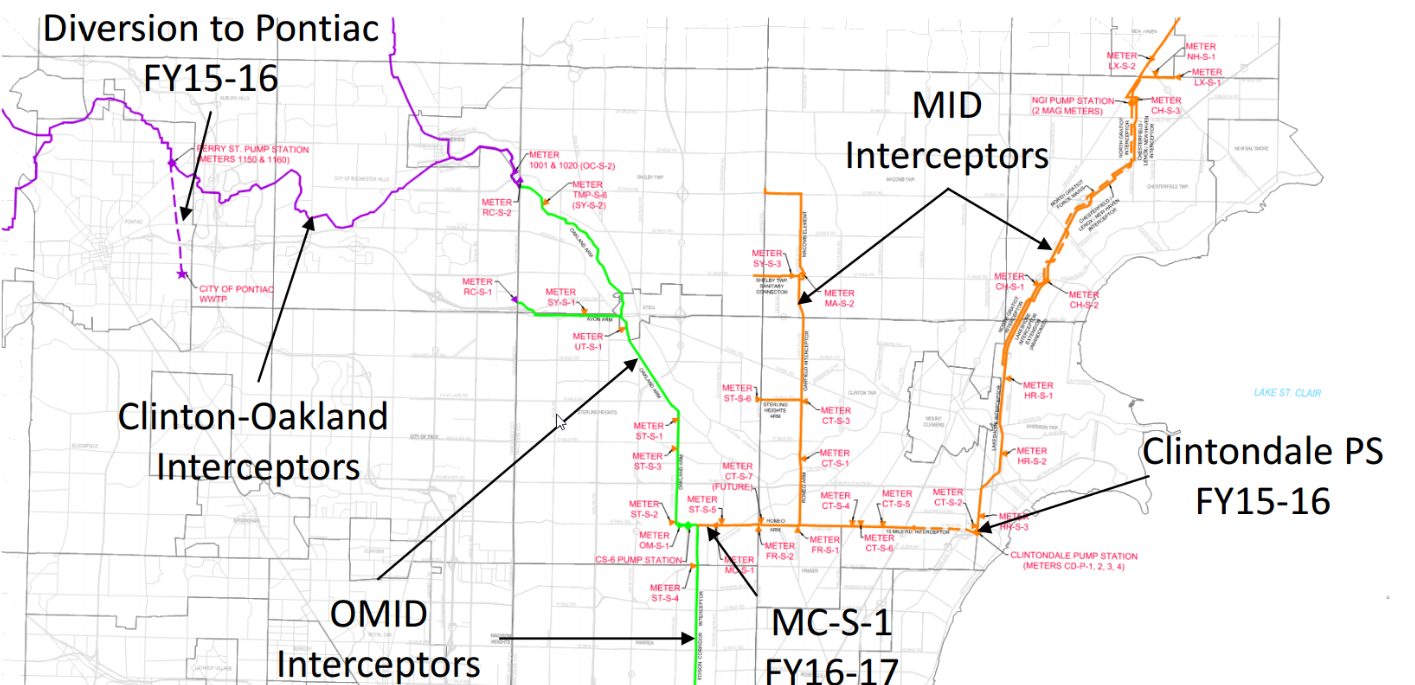
and Warren needs to be inter-connected as well.

Fresh Ideas on StormWater

On Saturday morning Feb 23, 2013 I had an opportunity to meet
Jim Nash – the new Oakland County Water Commissioner.
He spoke at The North Oakland Headwaters Land Conservancy
meeting in Springfield, Michigan. NOHLC is a non-profit,
community supported, citizen run organization conserving
the woods, fields, streams in the headwaters area of the
Clinton, Shiawassee, Huron and Flint Rivers.

I liked what I heard regarding sustainability, being green,
environmental consciousness, and stormwater management.

It’s easy to look at a map and see Oakland County is land locked.
All the water coming in/out of the county has to flow thru
other counties like Macomb to get to Lake St Clair/Detroit River.
A large portion of stormwater gets funneled into the Red Run.
The Interceptor Project from Oakland County will also flow
right thru the heart of Warren into Detroit.

Jim Nash has credentials well suited to the position.
He has a bachelor’s of science degree in political science.
Mr. Nash was on committees in the Sierra Club of Southeast Michigan.
He is also a member of the U.S. Green Building Council.

Red Run in Waterford,MI

In case you ever want to attend a meeting concerning
the Red Run Drain InterCounty Board – go to Waterford,MI

Red Run Drain Meetings

Red Run Drain Meetings

Red Run Combined Sewer Areas

Red Run Combined Sewer Areas

““““““““““““““““““““““““““““““““
OAKLAND COUNTY calling the shots on almost everything Red Run
Clinton River gets lots of water from Red Run flowing underground
into the Kuhn Retention Basin.

-

Out of sight and mind

We tend not to think about items we don’t see.
In our kitchens we just “expect” clean fresh water to be there
and hope the toilets will flush when we fill them.

Slowly people around metropolitan Detroit are becoming aware
of the funding inadequacies concerning underground infrastructure.

PBS recently released a short media clip concerning the
Oakland Macomb Interceptor project affecting many communities.

End of Jan 2013 stormwater levels

Flood stages upon the Clinton River :

http://water.weather.gov/ahps2/hydrograph.php?wfo=dtx&gage=fsrm4

When the Clinton River reaches – 16 ft
-Low spots near Millar Road begin to flood
-Water touches bridges at Garfield Road, Utica Road and Hayes Road.

When the Clinton River reaches – 17 ft
- Water pushes against bridges at Garfield Road, Utica Road and Hayes Road.

When the Clinton River reaches – 18 ft
- Water flows over the bridges at Garfield Road, Utica Road and Hayes Road.

USGS Graph for FSRM4

USGS Graph for FSRM4

Location of the Gauge

USGS Gauge Location

USGS Gauge Location

Warren’s sewer issues

Issues currently plaguing the Oakland and Macomb area :

Problem Area Macomb Interceptor

Problem Area Macomb Interceptor

High Water Table

The water table is only 5 to 20 feet below the ground’s surface;
while the sewer lines are buried 35 feet deep or more.
This results in significant water pressure,
acting on the outside of the plain concrete sewer pipes.
Inflow and Infiltration are constant threats.

Fine Sands and Silts

Both counties are located along the Mt. Clemens Moraine system.
The soils in this area were deposited as layers of silts and fine sands
at the depths commonly used by municipalities to bury sewer lines.
The water pressure at relatively shallow depths (only 5 ft underground)
can already force silt and fine sand through very fine cracks.
The end result is continually “clogged” pipes.

Old Monolithic Sewer Liners

Almost the entire old sewer pipe system was built with
no steel reinforcement in the concrete pipes.
The pipes merely rely on compression from soil support.

Step 1 – Fine Cracks Develop.
All concrete sewer liners crack as the liner flexes to
support the ground, and as the ground relaxes and
supports the concrete liner.
The action results in the liner forming a compression
ring to support the soil loads.
Such cracking typically occurs at the crown, invert and springlines;
and is typically not visible to the naked eye.
If construction joints are not installed
(which was not the practice for the old OMID system construction),
cracks also occur circumferentially, in response to shrinkage of
the concrete. These cracks may be visible to the naked eye.

Cracks in Concrete Sewer Pipes

Cracks in Concrete Sewer Pipes

Step 2 – Ground Water Pressure
Where groundwater is more than about 5 feet above a crack in a sewer,
seepage will begin. Where silt or silty fine sand is also present
immediately around the sewer lining, the silt-sized particles will
be carried through the cracks by the seeping water.
This may begin with a very slow rate of soil loss.

Water Pressure in Concrete Pipes

Water Pressure in Concrete Pipes

Step 3 – Voids and Loose Zones Form Around the Liner.
Over time, water seeping through relatively small
cracks will carry enough soil through the liner
to create loose zones and eventually voids around the lining.
This is a problem, because the monolithic lining is designed
to function as a perfect compression ring, and relies on the soil
surrounding the lining to support the lining under uniform pressure.
As the loose zones form, the monolithic lining flexes to maintain
the compression ring, and as it flexes, wider cracks open up,
in turn carrying more soil and larger particles of soil.

Voids in Concrete Sewer Pipe

Voids in Concrete Sewer Pipe

Step 4 – Large Voids Develop Around and Under the Sewer.
This step may or may not occur prior to
failure, depending on soil conditions.
As larger voids and loose zones develop, part of the barrel of the
sewer may lose support below the invert, and the sewer barrel
begins to “span” and deform downward across the loose zone or void.
As a result, diagonal stress cracking will begin to form,
bringing more soil into the sewer and further reducing support
from the surrounding soil, resulting in more deformation.

Large Voids in Concrete Sewer Pipes

Large Voids in Concrete Sewer Pipes

Step 5 – Extensive Deformation Occurs and Sewer Collapses.
This step may occur relatively quickly after Steps 3 or 4.
As larger and larger cracks open up following deformation
in Steps 3 and 4, larger sand particles and even gravel,
will flow into the sewer through the cracked and broken lining.
Catastrophic collapse and complete failure of the sewer lining occurs.

Collapse of Concrete Sewer Pipes

Collapse of Concrete Sewer Pipes

Source:
(Taken from NTH Consultants memorandums)
http://www.oakgov.com/water/documents/omi_final/appendix_e_public_doublesided.pdf

OMID Public Hearing Signatures

OMID Public Hearing Signatures

The people shown above signed a document explaining :
“”It is the intent of this project to perform extensive rehabilitation
of the OMID to return the facilities to a condition commensurate with
a minimum 20-year life span. The project will rehabilitate approximately
21.4 miles of sanitary sewer, repair an existing gate structure and
construct new control gates.”"

The City of Warren, Michigan will eventually be hooked into
the newly renovated Oakland Macomb Interceptor Project .

Red Run inter-county Trail Corridor

Macomb County Trailways Master Plan

Macomb County Trailways Master Plan

Regional Corridors
Two regional routes bisect within the City of Warren,
- an east-west route along the Red Run Drain
connecting the Warren Community Center and Library
into Madison Heights and Freedom Hill County Park,
- a north-south route, primarily within the
ITC corridor and connecting into the planned
Conner Creek Greenway and Detroit River.

The Red Run Drain is some of the only contiguous open space
remaining within the City of Warren (the 3rd largest city in Michigan)
which is home to around 134,000 people.

MDOT is part of the Red Run Inter-County Drain Board
- as are numerous cities in Oakland County .

Joseph Vicari & Hank Riberas are new members of Warren DDA 2013.
Both are part of Hillside Productions, which promotes entertainment
events at Freedom Hill County Park in Sterling Heights.

The Red Run Drain even got a new Water Commissioner for 2013.
http://redrundrain.wordpress.com/kuhn-facility-and-red-run/new-water-commissioner-oakland-county/

Maybe we’ll see some new Bike Paths in the near future ?
http://redrundrain.files.wordpress.com/2011/10/red-run-bike-path.jpg

Oakland County Parks on Dequindre Road were created “because” of the
12 Towns Retention Basin aka Kuhn Facility which releases storm water
into Warren via the Red Run & Clinton River out to Lake St. Clair.

Now some in the community will play a “game” of NIMBY;
aka “not in my back yard” but it is utter foolishness.
The Red Run navigable waterway is well over 200 years old.
Many courts will say “water trail” law precedes the law of the dirt,
- since it came first and foremost in our developing country.

The NIMBY thing boils down to lazy convenience for many
living along the Red Run Drain the past 100 years.
- easy access to dump what you want, when you want.
- don’t have to bag your grass clippings.
- don’t have to bag leaves, branches, etc.

Nobody is planting gardens extending to the middle of the Red Run
or even along it’s banks as the county maintains a right-of-way
for emergency access 24 hours a day, 365 days a year.
One year, county officials actually plowed snow along the Red Run,
so that a contractor’s vehicles could drive along the banks.
True story – I called, wondering why my snowshoe tracks were plowed away.
I was trying to avoid the cross country ski tracks, out of respect.
People ALREADY walk along it daily, giving their dogs “bathroom exercise”.

Let’s address the irrational fear of property trespass
for a bicyclist merely wants to cycle along the path,
on their way to another destination.

We already let public corporation people on our property.
- postal personnel
- utility meter readers
- newspaper delivery people
- girl scouts/ boy scouts

What makes a backyard different from a front yard ?
- the fence ?
- the berm ?
- the shrubs ?

Some neighborhoods have no fences delineating the property line.
We all know the Sidewalk is city property, we don’t own that.
We usually have a Front Lawn next to a drive, avenue, boulevard, etc.
often with a City planted tree and yet mow the grass anyways.
People walk in front of houses, on that City Sidewalk, everyday.
Theft: people can steal from you now, so that argument falls apart.

Easement, versus County Access , versus actual Trespass rules.
People irrationally feel the need to be selfish; instead of
helping the community create something for the better good of all.

Warren could use something that DRAWS people into the city

While the log floatation test was the old yardstick
by which many “navigability” claims were measured;
-it is “how” modern waterways best serve the public
(as historical intent of law)
that allows recreational usage to be considered
in the determination of navigability.

The capacity for beneficial public service is
paramount towards being deemed navigable.
Courts long ago adopted a rule of
“capacity for use to meet public necessity”
as the true test.

Waterways are public paths, expected to be open to travel use.
This public expectation is still valid today in a modern society.

Drinking water under Red Run

We tend to forget how things are built – until they need fixing.
The water mains in northern Warren,MI go “under” the Red Run Drain.
A recent repair contract will soon take place on Ryan Road.

~~~~~ click to enlarge picture ~~~~~

Drinking water under Red Run

Drinking water under Red Run

Follow

Get every new post delivered to your Inbox.